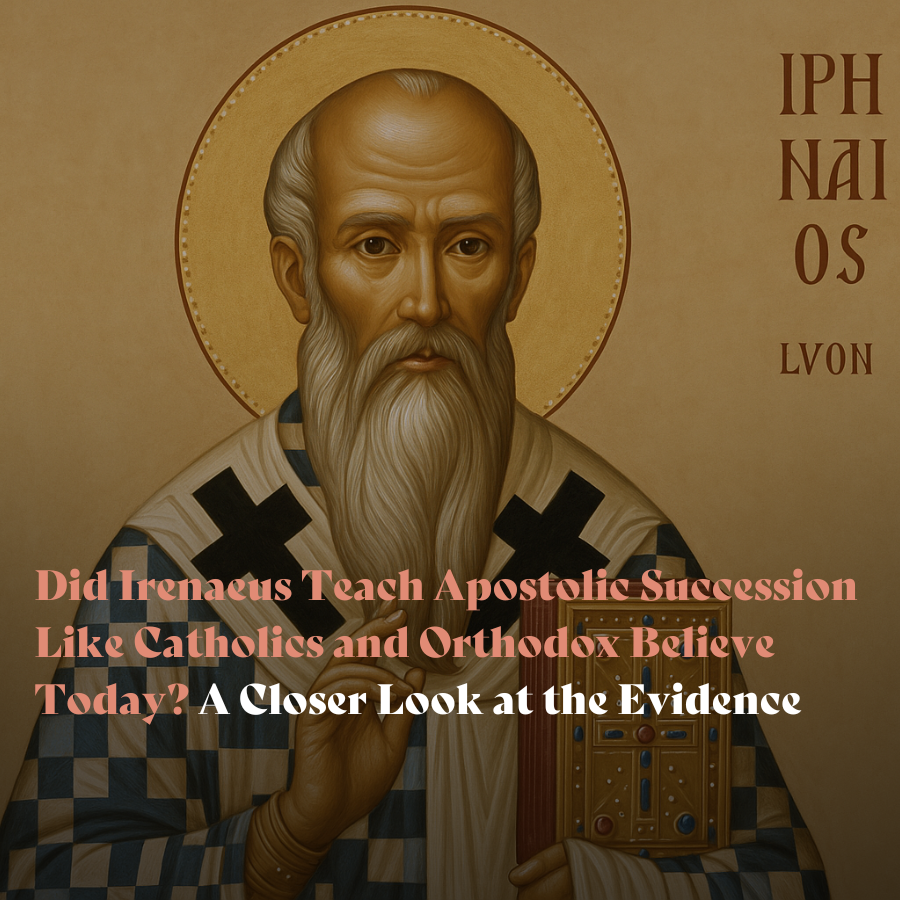
Was Irenaeus’ Argument for Apostolic Succession Biblical? A Critical Examination

Updated: Apr 12
If you spend any amount of time engaging with theology, apologetics, or even casual Christian conversations, you will begin to notice a pattern. Arguments are often evaluated based on whether they are persuasive, whether they are effective, or whether they seem to “work.” If an argument appears to win the exchange or silence the opposition, it is often assumed to be a good argument. But that raises a deeper question that we rarely stop to ask: by what standard are we evaluating these arguments in the first place?
For the Christian, the ultimate question cannot simply be whether something is persuasive. It must be whether it is biblical. That is a fundamentally different posture. One is concerned with results, the other with faithfulness. One asks what is effective, the other asks what God has actually revealed and prescribed. And the difference between those two approaches is not small. It shapes how we handle truth, how we defend the faith, and ultimately how we think about authority itself.
This is where Irenaeus of Lyons becomes an important case study. Irenaeus was a faithful defender of the Christian faith in the second century, particularly in his opposition to Gnostic teachings. His work has been used by God to preserve and clarify essential truths about the gospel and the person of Christ. But within his defense, he also employed a particular line of argumentation, specifically his appeal to apostolic succession, that deserves careful examination.
The goal of this discussion is not to tear down Irenaeus, nor to diminish his contribution to the church. Rather, it is to ask a more careful question: was his argument not only useful in its context, but was it ultimately biblical as a standard for preserving truth? Because if we do not ask that question, we may find ourselves adopting methods simply because they appear to work, rather than because they reflect the pattern that Scripture itself gives us.
The Historical Context: What Problem Was Irenaeus Solving?
Before we evaluate the argument itself, we need to understand the situation that gave rise to it. Irenaeus of Lyons was not writing in a vacuum. He was responding to a growing and dangerous movement in the second century known as Gnosticism.
The Gnostics were not simply offering a different interpretation of Christianity. They were making a much more radical claim. They taught that true understanding of Christ and salvation came through secret knowledge, a hidden tradition that had allegedly been passed down from the apostles to a select few. This knowledge was not public, not openly proclaimed, and not accessible to the broader church. It existed behind the scenes, preserved only for those who had been initiated into it.
This created an immediate problem. If someone claims to possess a secret apostolic tradition, how do you test that claim? How do you verify something that, by definition, is hidden and inaccessible? If the standard of truth becomes private revelation or secret transmission, then there is no meaningful way to distinguish between what is genuinely apostolic and what is simply invented.
Irenaeus’ response to this challenge was both strategic and understandable. Instead of chasing after hidden claims, he pointed to something visible and public. He appealed to the churches that had been founded by the apostles and to the succession of leaders within those churches. His reasoning was that if the apostles entrusted their teaching to these churches, and if that teaching had been handed down through a recognizable line of leaders, then those churches would stand as reliable witnesses to what the apostles actually taught.
In that context, the argument carries real weight. Irenaeus is not appealing to something mystical or unverifiable. He is drawing a contrast between secrecy and publicity, between hidden claims and observable continuity. He is saying, in effect, that the truth is not locked away in secret traditions but is openly preserved in the life and teaching of the apostolic churches.
And that is important to recognize. At this stage, his argument is functioning as a historical rebuttal to a specific problem. He is pushing back against the Gnostic appeal to secrecy by pointing to public continuity. When understood in its original context, the move makes sense. But the question we now need to ask is whether that move, once extended beyond its original purpose, can actually serve as a reliable and biblical standard for preserving truth.
Irenaeus’ Argument in His Own Words
To evaluate the argument fairly, we need to hear it directly from Irenaeus of Lyons himself. Rather than relying on summaries or later interpretations, we should look at how he presents his case in his own words.
In Against Heresies, Book 3, Chapter 3, Irenaeus writes:
“We can enumerate those who were established by the apostles as bishops in the churches, and their successors down to our own times, those who neither taught nor knew of anything like what these heretics rave about.”
(Irenaeus, Against Heresies 3.3.1)
He continues by emphasizing the significance of this continuity, especially with respect to the church at Rome:
“For it is a matter of necessity that every Church should agree with this Church, on account of its more excellent origin, that is, the faithful everywhere, inasmuch as the apostolic tradition has been preserved continuously by those who exist everywhere.”
(Irenaeus, Against Heresies 3.3.2)
What Irenaeus is doing here is clear. He is appealing to a visible, traceable line of succession from the apostles to the present leaders of the church. His claim is that this continuity serves as evidence that the teaching preserved within these churches is the same teaching originally handed down by the apostles. In contrast to the Gnostics, who appeal to hidden and unverifiable traditions, Irenaeus points to something public, structured, and historically grounded.
At this stage, it is important not to rush into critique. Irenaeus is making a serious argument, and one that is rooted in his desire to defend the truth of the gospel against distortion. The question is not whether he is sincere, nor whether his intentions are good. The question is what exactly his argument is claiming, and whether that claim can bear the weight that is being placed upon it.
Clarifying the Argument: What Is Being Claimed?
Now that we have heard Irenaeus of Lyons in his own words, we can begin to clarify exactly what his argument is doing. This step is important because arguments are often persuasive not simply because of what they say, but because of what they assume.
At its core, Irenaeus’ reasoning follows a clear line. The apostles received the truth from Christ and entrusted that truth to leaders within the churches they established. Those leaders then passed that teaching down to their successors, forming a continuous line from the apostolic age to his present day. Because this line can be identified and traced, it serves as a public witness against the secret and unverifiable claims of the Gnostics.
Up to this point, the argument functions as a historical appeal. It is pointing to continuity as evidence that the teaching found in these churches aligns with what the apostles originally delivered. But within that appeal, a deeper assumption begins to emerge. The argument does not remain at the level of historical likelihood. It begins to suggest something stronger, that this succession is not only evidence of continuity, but a reliable indicator, and potentially even a guarantor, of doctrinal truth.
That is the critical point. The force of the argument rests on the idea that proximity to the apostles, mediated through a chain of leaders, safeguards the integrity of the message. In other words, if a church can trace its leadership back to the apostles, then its teaching can be trusted as faithful to the apostolic deposit.
And this is where we need to slow down. Because once succession is treated not merely as a historical observation but as a principle that ensures the preservation of truth, the question becomes unavoidable. Is that actually how Scripture itself describes the transmission and safeguarding of the gospel? Or has the argument moved beyond what can be supported by the biblical witness?
Pressure Testing the Argument: A Biblical Evaluation
If the claim is that succession functions as a reliable indicator, and potentially even a safeguard, of doctrinal truth, then the next step is not speculation but Scripture. We must ask whether the Bible itself supports that assumption. And when we turn to the text, what we find is not a reinforcement of that idea, but a consistent pattern that challenges it.
Churches Can Depart from the Gospel
Epistle to the Galatians 1:6–9 (LSB):
“I am amazed that you are so quickly deserting Him who called you by the grace of Christ for a different gospel, which is really not another, only there are some who are disturbing you and want to distort the gospel of Christ. But even if we, or an angel from heaven, should proclaim to you a gospel contrary to what we have proclaimed to you, let him be accursed! As we have said before, so I say again now, if anyone is proclaiming to you a gospel contrary to what you received, let him be accursed!”
This is not written to a fringe group detached from apostolic influence. This is a church that had received the gospel through apostolic ministry. And yet, despite that proximity, they are already turning to another gospel. Paul does not direct them to examine a chain of succession. He directs them back to the message they originally received. The standard is not lineage, but the gospel itself.
Leaders Can Corrupt and Oppose the Truth
Third Epistle of John 9–10 (LSB):
“I wrote something to the church; but Diotrephes, who loves to be first among them, does not accept what we say. For this reason, if I come, I will call attention to his deeds which he does, unjustly accusing us with wicked words; and not satisfied with this, he himself does not receive the brothers, either, and he forbids those who desire to do so and puts them out of the church.”
Here we have a leader within the church, not outside of it, actively rejecting apostolic authority. His position did not preserve the truth. In fact, it became the very platform from which he opposed it. This directly challenges the assumption that being within a recognized line of leadership ensures doctrinal faithfulness.
Elders Can Arise from Within and Distort Doctrine
Acts 20:29–30 (LSB):
“I know that after my departure savage wolves will come in among you, not sparing the flock; and from among your own selves men will arise, speaking perverse things, to draw away the disciples after them.”
Paul is speaking to the elders of the church in Ephesus, a church with direct apostolic investment. And yet he warns that from among those very leaders, men will arise who distort the truth. The danger is not merely external. It is internal. It arises within the very structure that succession is supposed to protect.
Churches Can Be Rebuked by Christ Himself
Revelation 2:4–5 (LSB):
“But I have this against you, that you have left your first love. Therefore remember from where you have fallen, and repent, and do the deeds you did at first; or else I am coming to you and will remove your lampstand out of its place, unless you repent.”
These are real churches, with real histories, and yet they are subject to rebuke and even removal. Their existence and continuity do not guarantee their faithfulness.
Conclusion of the Biblical Witness
When we bring these passages together, a consistent pattern emerges. Scripture does not present succession, position, or proximity as a safeguard of truth. Instead, it repeatedly warns that error can arise within churches, within leadership, and even within communities that have directly received apostolic teaching.
This does not mean that continuity is meaningless. But it does mean that continuity is not sufficient. The preservation of truth is not guaranteed by a chain of leaders. It is measured by fidelity to the apostolic message itself.
As Keith A. Mathison explains in The Shape of Sola Scriptura:
“The church is not an autonomous authority standing over Scripture, nor is it an infallible interpreter alongside Scripture. Rather, the church is always subject to the authority of Scripture and is to be continually reformed by it.”
This reinforces the point that continuity of leadership cannot function as a safeguard of truth if the church itself remains accountable to a higher, unchanging standard.
The Hypothetical Gnostic Response
At this point, it is worth pausing and asking a simple but important question. If Irenaeus of Lyons presented this argument to a thoughtful and informed opponent, how might they respond?
If we allow the Gnostic to answer using the very pattern we just saw in Scripture, the response becomes surprisingly straightforward:
“Even if we grant your list of bishops, why should we assume that they preserved the truth? Your own Scriptures show that churches can abandon the gospel, that leaders can oppose apostolic teaching, and that elders can arise from within and distort doctrine. If that is the case, then your appeal to succession does not prove what you think it proves. It may show continuity of leadership, but it does not guarantee continuity of truth.”
That response exposes the tension at the heart of the argument. Irenaeus is attempting to establish a reliable, public standard to counter hidden and unverifiable claims. But if the standard he appeals to can itself be shown, from Scripture, to be vulnerable to corruption, then it cannot function as a decisive proof of doctrinal fidelity.
This does not mean that his argument is meaningless or without value. It means that it is limited. It can challenge the Gnostic appeal to secrecy, but it cannot, on its own, establish that a given church or lineage has preserved the truth without error.
And this is where the distinction becomes crucial. A historical argument can be helpful in a specific context, but once it is treated as a universal principle, it can be pressed in ways that expose its weakness. The Gnostic does not need to deny the existence of succession. He only needs to question its reliability as a safeguard of truth.
The Shift: From Helpful Argument to Dangerous Principle
At this point, the issue begins to come into clearer focus. What Irenaeus of Lyons originally employed as a contextual and strategic argument begins to take on a life of its own.
In its original setting, the appeal to succession functioned as a historical rebuttal. It exposed the weakness of the Gnostic claim to secret knowledge by pointing to something public and verifiable. It said, in effect, that the truth of the gospel was not hidden in private traditions but openly preserved in the life of the churches. In that sense, the argument had real force. It addressed a specific problem in a specific moment.
But over time, the argument was no longer treated as merely contextual. It was elevated into something more. What began as an appeal to public continuity gradually became a principle for establishing doctrinal authority. Instead of being one piece of historical evidence, succession started to function as a standard by which truth itself could be identified and verified.
And that is where the problem emerges. Because once succession is treated as a guarantee of truth, it is being asked to do something that Scripture itself does not assign to it. The argument has moved from being a helpful response to a particular error to becoming a framework that shapes how authority is understood more broadly.
This shift is subtle, but its implications are significant. It changes the question from, “What did the apostles teach?” to, “Who stands in the line of the apostles?” It moves the focus from the content of the message to the continuity of the messenger. And when that shift takes place, the ground of authority is no longer anchored as firmly in the apostolic proclamation itself.
This is how a well intentioned argument can create unintended consequences. Not because it was entirely wrong in its original context, but because it was later extended beyond what it was ever meant to bear.
Modern Parallels: The Same Method Today
What makes this discussion more than a historical exercise is the fact that the same pattern of reasoning has not disappeared. It continues to surface in different forms, often with the same underlying assumption, that a chain of authority can function as a reliable validation of truth.
A clear example of this can be seen in Mormonism. While the system itself is different from second century Gnosticism, the methodological move bears a resemblance. Authority is established through claims of restoration, prophetic succession, and a line of transmission that is said to connect modern leadership to divine revelation. The appeal is not first to a publicly testable message, but to the legitimacy of the authority structure itself.
Now to be clear, the claim being made here is not that these systems are identical. They are not. But the underlying approach shares a common feature. Truth is grounded in a chain, a lineage, or an authority structure that is treated as inherently reliable. The argument moves from, “What is the content of the message?” to, “Who has the authority to deliver it?”
And that is precisely the kind of shift we saw earlier. Once succession or authority becomes the primary lens through which truth is evaluated, the focus subtly moves away from the message itself. Instead of testing claims against a fixed and public standard, the weight is placed on the legitimacy of the source.
This is why the issue matters. Because if the method itself is flawed, it does not remain confined to one historical moment. It becomes a pattern that can be repeated, adapted, and applied in ways that lead people away from the very standard that Scripture provides. And in each case, the same assumption is at work, that continuity of authority can stand in as a guarantee of truth.
But that brings us back to the central question. Even if a method appears persuasive, even if it has been used effectively in the past, is that enough to justify its use? Or do we need to ask something deeper, something more foundational, about whether the method itself aligns with the way Scripture calls us to handle the truth?
The Real Question: Was It Biblical or Just Effective?
At this point, we arrive at the question that sits beneath everything we have discussed so far. Not whether the argument was persuasive. Not whether it was useful in a particular moment. But whether it was biblical.
This is where many Christians, often without realizing it, adopt a posture that is closer to pragmatism than to Scripture. If an argument seems to work, if it appears to defend the faith successfully, it is assumed to be acceptable. But that is not the standard the apostles give us. The issue is not simply whether we arrive at the right conclusion, but whether we handle the truth in the way God has prescribed.
First Epistle to the Corinthians 2:1–5 (LSB):
“And when I came to you, brothers, I did not come with superiority of word or of wisdom, proclaiming to you the witness of God. For I determined to know nothing among you except Jesus Christ, and Him crucified. And I was with you in weakness and in fear and in much trembling, and my word and my preaching were not in persuasive words of wisdom, but in demonstration of the Spirit and of power, so that your faith would not be in the wisdom of men, but in the power of God.”
Paul is not merely describing his preaching style. He is establishing a principle. The power of the gospel does not rest in rhetorical effectiveness or persuasive technique. It rests in the truth itself and in the work of God. That means the Christian is not free to rely on whatever method seems most convincing. He is bound to handle the truth in a way that reflects its divine origin.
As Greg Bahnsen writes in By What Standard? God’s World, God’s Rules:
“If we are to reason properly, we must reason in submission to God’s Word, not setting ourselves up as judges over it, but allowing it to be the standard by which all reasoning is evaluated.”
This sharpens the issue. The problem is not merely using weak arguments. It is placing ourselves in the position of determining what methods are acceptable apart from the standard God has given.
This is reinforced even more explicitly in 2 Corinthians 4:2 (LSB):
“But we have renounced the things hidden because of shame, not walking in craftiness or adulterating the word of God, but by the manifestation of the truth commending ourselves to every man’s conscience in the sight of God.”
Notice the contrast. Paul rejects craftiness. He rejects manipulation. He rejects any approach that distorts or mishandles the word of God, even if it might produce results. Instead, he commits himself to the open and faithful presentation of the truth.
This brings us back to the issue at hand. Even if an argument appears to be effective, even if it seems to strengthen the case for Christianity in a particular context, that is not enough to justify it. The question we must ask is whether the method itself aligns with the pattern we see in Scripture. Are we appealing to what God has revealed, or are we relying on structures, assumptions, or strategies that Scripture itself does not authorize?
The Christian is not free to defend the truth however he chooses. He is bound to defend it in the way God has made known. And that standard does not change based on what appears to work.
The Strength of Limitation: Why Biblical Boundaries Matter
At first glance, this kind of framework can feel restrictive. If we are bound to defend the truth only in ways that Scripture authorizes, then that necessarily limits the kinds of arguments we can make and the strategies we can employ. It removes certain rhetorical shortcuts. It prevents us from leaning on methods that may appear persuasive but are not grounded in the biblical pattern.
But what may seem like a limitation is actually a safeguard.
When we are confined to what God has revealed, we are protected from drifting into subtle forms of manipulation, exaggeration, or misplaced confidence. We are forced to rely not on the cleverness of our arguments, but on the clarity and sufficiency of the truth itself. This does not weaken our apologetic. It purifies it.
This is precisely the concern that runs through the apostolic witness. The goal is not merely to win arguments, but to present the truth in a way that is consistent with its source. When we move beyond that, even with good intentions, we begin to place our confidence in methods rather than in God.
And that is where the danger lies. Because once effectiveness becomes the standard, the door is opened to all kinds of approaches that may produce results but do not reflect the character of the truth we are called to defend. The issue is no longer just what is being said, but how it is being said and what it ultimately trains people to trust.
By contrast, when we accept the boundaries that Scripture sets, something important happens. Our confidence shifts. It is no longer rooted in our ability to construct the most compelling argument, but in the power of the truth itself. We are reminded that the task of the Christian is not to engineer belief through persuasive technique, but to faithfully proclaim what God has made known.
This is not a weakness. It is a strength. It ensures that our defense of the faith remains anchored in the very revelation we are seeking to uphold. And it keeps us from building something that may look impressive on the surface, but lacks the substance that can endure.
A Better Standard: The Apostolic Message Preserved in Scripture
If succession cannot function as a guarantee of truth, then the question naturally follows: what does? How does Scripture itself describe the preservation and verification of the apostolic message?
The answer is not found in an unbroken chain of leaders, but in a fixed and public standard, namely the message that the apostles proclaimed and committed to writing. The authority of the church does not rest in its ability to trace a line of succession, but in its faithfulness to the apostolic witness.
This is why the New Testament consistently directs believers back to the content of the message rather than to the continuity of a structure. The gospel is something that is preached, received, and held fast. It is not something that is safeguarded merely by being passed along through a line of office holders. It must be preserved through fidelity to what was originally delivered.
We see this clearly in passages like 2 Timothy 1:13–14, where Paul exhorts Timothy to retain the standard of sound words he has heard and to guard the good deposit entrusted to him. The emphasis is not on Timothy’s place in a chain, but on his responsibility to preserve the message itself. The same pattern appears in Jude 3, where believers are urged to contend earnestly for the faith that was once for all handed down to the saints. Again, the focus is on the faith as a defined body of truth, not on a lineage that guarantees its purity.
This does not mean that leadership is unimportant. It means that leadership is accountable to the message, not the other way around. The authority of any teacher, elder, or church is derivative. It is measured by conformity to the apostolic teaching preserved in Scripture.
As emphasized in The Sufficiency of Scripture, with contributors such as John MacArthur:
“Scripture is sufficient in that it is the only infallible rule of faith and practice, containing all that is necessary for salvation and for living a life that is pleasing to God.”
When that standard is maintained, the church stands in continuity with the apostles. When it is not, no appeal to succession can compensate for the departure.
This brings clarity to the issue. The preservation of truth is not secured by proximity, position, or lineage. It is secured by fidelity to the apostolic message, a message that God, in His wisdom, has preserved in written form so that it may be publicly known, tested, and held fast across generations.
And this provides something far more stable than a chain of succession. It provides a standard that does not shift, does not depend on the integrity of any one leader, and does not require an appeal to hidden or inaccessible authority. It anchors the believer directly in what God has revealed.
Building Carefully: A Biblical Way to Honor Faithful Men
At this point, it would be easy to swing too far in the other direction. Having identified a weakness in the argument, one might be tempted to dismiss the man altogether. But that would be just as unbiblical as uncritically accepting everything he said. Scripture gives us a better category, one that allows us to be both honest and charitable at the same time.
First Epistle to the Corinthians 3:10–15 (LSB):
“According to the grace of God which was given to me, like a wise master builder I laid a foundation, and another is building on it. But each man must be careful how he builds on it. For no one can lay a foundation other than the one which is laid, which is Jesus Christ. Now if anyone builds on the foundation with gold, silver, precious stones, wood, hay, straw, each man’s work will become evident, for the day will indicate it because it is revealed with fire, and the fire itself will test the quality of each man’s work. If any man’s work which he has built on it remains, he will receive a reward. If any man’s work is burned up, he will suffer loss, but he himself will be saved, yet so as through fire.”
The apostles make it clear that there is a distinction between the foundation and what is built upon it. The foundation is fixed, it is Christ and the gospel that was once for all delivered. But the way men build upon that foundation can vary. Some build with care and clarity, others with less precision. Some arguments endure under scrutiny, others do not. Yet all of this takes place on the same foundation.
This is where Irenaeus of Lyons must be understood. He was a faithful servant of Christ who stood firmly on the right foundation. He opposed serious error, defended essential truths, and was used by God to preserve clarity in a time of confusion. That should not be minimized. His contribution matters, and it should be recognized with gratitude.
At the same time, faithfulness in ministry does not mean perfection in argumentation. It is possible to defend the truth while employing reasoning that does not fully align with the pattern we see in Scripture. And when that happens, the appropriate response is not to ignore the issue, but to evaluate it carefully.
This is not an act of disrespect. It is an act of obedience. Because honoring those who came before us does not mean treating their words as beyond examination. It means building more carefully on the same foundation they stood on. It means learning not only from what they got right, but also from where their reasoning may fall short.
In doing so, we avoid two errors. We avoid the error of dismissing faithful men because they were not perfect, and we avoid the error of uncritically adopting everything they said simply because of who they were. Instead, we take the posture that Scripture calls us to, one that evaluates all things in light of the truth, holds fast to what is good, and continues building with greater care.
What Standard Will You Use?
At the end of all of this, the issue is not ultimately about Irenaeus of Lyons. It is about the standard we choose to adopt when we think about truth, authority, and how the Christian faith is to be defended.
It is easy to default to what appears effective. An argument seems persuasive, it gains traction, it silences opposition, and before long it becomes part of how we think. But if we are not careful, we can begin to measure faithfulness by results rather than by conformity to what God has revealed. And when that happens, we may find ourselves defending the truth in ways that subtly undermine the very foundation we are trying to uphold.
The alternative is not to abandon apologetics or to retreat from engaging error. It is to be more careful, more deliberate, and more anchored in Scripture. It is to ask not only whether something sounds convincing, but whether it reflects the pattern that God Himself has given us for handling truth.
This requires discipline. It requires humility. It requires a willingness to say no to certain kinds of arguments, even when they seem helpful on the surface. But in doing so, it keeps our confidence where it belongs, not in our ability to construct persuasive reasoning, but in the power and clarity of what God has made known.
So the question is simple, but it is not easy. When you evaluate an argument, whether from the early church, from modern teachers, or even from your own reasoning, what standard are you using? Are you asking whether it works, or are you asking whether it is biblical?
Because in the end, that distinction will shape not only how you defend the faith, but how you understand it.
Book Recommendations
The Shape of Sola Scriptura by Keith A. Mathison
By What Standard? God’s World, God’s Rules by Greg Bahnsen
The Sufficiency of Scripture edited by Don Kistler
© 2026 Jayni Jackson. All rights reserved.
Scripture quotations are from the ESV® Bible (The Holy Bible, English Standard Version®), unless otherwise noted.
Written by Jayni Jackson, creator of Least of These Podcast.
You may share this article with proper attribution, but you may not reproduce it in full without written permission.
If this article helped you think more clearly about Scripture, consider sharing it or subscribing for more content.
Comments