Should Christians Call Mary “Our Mother”? Biblical Authority, Church History, and the Limits of Theological Language
- Jayni Jackson

- Apr 12
- 15 min read
Have you ever stopped and really thought about what we mean when we call Mary “our mother”? For many Christians, especially within long-standing traditions, that language feels deeply reverent, warm, and even spiritually meaningful. It sounds right, it feels right, and because it has been repeated for centuries, it is often assumed to be right.
But that raises a question that we rarely slow down long enough to ask: where does Scripture actually teach us to speak this way? Not where tradition suggests it, not where it feels natural, but where God Himself has revealed it. Because for the Christian, the ultimate question cannot be whether something is meaningful, it must be whether it is biblically warranted.
Now to be clear, this is not about diminishing Mary. Scripture itself says that she is “blessed among women” and presents her as a model of humility and faith. The goal here is not to tear down what God has honored, but to make sure that our language and devotion do not go beyond what God has revealed.
At the heart of this discussion is a simple but crucial issue: who has the authority to define our theological categories? Because once we begin introducing relational language that Scripture itself does not establish, we are no longer simply explaining the faith, we are expanding it. And that is where clarity begins to give way to confusion.
Why Theological Language Must Be Regulated by Scripture
The way we speak about God, salvation, and the Christian life is never neutral. Theological language does not just describe what we believe, it shapes how we believe, how we relate, and ultimately how we worship. That means even small shifts in terminology can carry massive theological implications over time.
History shows us that doctrines rarely drift overnight. Instead, they often develop through subtle expansions of language, where terms that were once precise begin to stretch beyond their original meaning. What starts as a helpful way of speaking can slowly become a new category of belief, especially when it is repeated often enough without being carefully examined against Scripture.
This is why Scripture must function not only as the foundation of our doctrine, but also as the boundary for our language. We are not free to create new ways of speaking about spiritual realities simply because they feel meaningful or helpful. If God has not revealed a category, then no matter how compelling it sounds, it does not carry divine authority.
At the end of the day, the issue is not whether a phrase like “our mother” sounds reverent. The issue is whether it is authorized by God’s Word. Because meaningful language is not necessarily biblical language, and when those two are confused, theology begins to drift in ways that are often hard to detect at first, but significant over time.
What Scripture Actually Says About Mary
Before we critique anything, we need to start where Scripture starts, and that means honoring Mary exactly as the Bible does. She is not a minor figure in redemptive history, she is uniquely chosen by God to bear the Messiah. Elizabeth calls her “blessed among women”, and Mary herself declares that “all generations will call me blessed”, which means any faithful Christian theology must take her role seriously.
Mary is presented as a model of humility and obedience. When she says, “Behold, I am the servant of the Lord; let it be to me according to your word,” we are seeing a profound example of faith in action. She trusts God’s promise, submits to His will, and participates in one of the most significant moments in all of history, the incarnation of Christ.
But here is where we have to be just as careful. Scripture gives us a high view of Mary, but it is also a defined view of Mary. Nowhere are we told that she has an ongoing role in the life of the believer beyond her place in the historical unfolding of redemption. There is no passage that presents her as a mediator, no instruction to relate to her devotionally, and no indication that she functions as a spiritual mother to the church.
That boundary matters. Because if we go beyond what Scripture actually says, even with good intentions, we are no longer simply honoring Mary, we are redefining her role. And the question we have to keep asking is not, “Does this sound reverent?” but rather, “Has God revealed this?”
The Silence of the Apostles and Its Theological Weight
At this point, we need to ask a question that is both simple and extremely revealing: if Mary is truly the spiritual mother of all believers, why do the apostles never say so? This is not a minor detail, it goes to the heart of how Christian doctrine is formed. Because the apostles are not just historical figures, they are the authorized interpreters of Christ’s work and the foundation of the church’s teaching.
When you read through Acts, Mary is present, but she is not central. She is among the believers, praying with them, but she is never elevated into a unique role within the life of the church. As the New Testament unfolds, and especially when you move into the epistles, something even more striking happens: Mary is completely absent from the theological instruction given to the churches.
Think about that for a moment. The apostles write extensively about salvation, the church, prayer, suffering, leadership, and the Christian life. They carefully define our relationship to the Father, the Son, and the Spirit. And yet, in all of that teaching, they never once present Mary as a spiritual mother, nor do they instruct believers to relate to her in any ongoing way.
That kind of silence is not accidental. It is theologically meaningful. If something is essential to how believers understand their identity, their relationships, and their devotion, we would expect it to be clearly taught and consistently reinforced. But in this case, the absence speaks loudly: the apostles did not operate with this category, and they did not pass it on to the church.
Biblical Familial Language — Real, But Defined and Limited
At this point, someone might respond by saying, “But Scripture does use family language spiritually, so why couldn’t Mary be our mother in that sense?” That’s a fair question, and it forces us to be precise. Because the Bible absolutely does use familial categories, but it never leaves them undefined or open-ended.
Take Paul the Apostle, for example. He explicitly tells certain believers, “I became your father in Christ Jesus through the gospel.” That is real spiritual language, and it is meaningful. But notice how carefully it is framed, it is directed to specific people, grounded in a specific ministry, and limited to a defined relationship.
The same is true when Scripture uses broader imagery, like calling the “Jerusalem above” our mother. Even there, the meaning is explained within the context of redemptive history and covenant theology. In every case, Scripture defines what the metaphor means, how far it extends, and what it does not imply.
That is the key difference. When the Bible uses familial language, it does so with clarity, boundaries, and purpose. But when people say “Mary is our mother,” none of those things are present. The category is not explained, the scope is not defined, and the relationship is not grounded in any explicit teaching. And that is where the problem begins, because biblical metaphors are meant to illuminate truth, not create new, undefined categories of belief.
John 19:26–27 — Provision, Not Universalization
The passage most often used to support the idea that Mary is “our mother” is found at the cross. As Jesus is dying, He looks at John the Apostle and says, “Behold your mother,” and to Mary, “Behold your son.” At first glance, it can sound like something more than a personal exchange, but when we slow down and examine the context, the meaning becomes much clearer.
In that moment, Jesus’ biological brothers did not yet believe in Him, and they were not present in the same way as His disciples. John, however, is standing there, faithful to the very end. So what Jesus is doing is not establishing a universal doctrine, He is making a practical and compassionate provision for His mother, entrusting her care to someone who belongs to His true, believing family.
And this actually fits perfectly with Jesus’ broader teaching. Earlier, He redefined family by saying that whoever does the will of God is His brother, sister, and mother. So here at the cross, we are not seeing Mary’s role expanded outward to all believers, we are seeing biological ties placed within the context of spiritual family.
That distinction is crucial. Because if we take a deeply personal, situational moment and turn it into a universal theological category, we are doing something the text itself never does. This passage shows us Jesus’ care and His redefinition of family, not the establishment of Mary as the spiritual mother of the church.
The Inconsistency Test — Why Not Paul Too?
At this point, we need to step back and ask a question about how we are interpreting Scripture, not just what we are concluding from it. Because if John 19 is being used to establish a universal category, then that interpretive move needs to be applied consistently elsewhere. And when we do that, the problem becomes immediately clear.
If Jesus’ words to John, “Behold your mother,” are meant to establish Mary as the mother of all believers, then by the same reasoning, when Paul the Apostle says, “I became your father in Christ Jesus,” we would have to conclude that Paul is the father of all Christians. But no one makes that argument, because we instinctively recognize that Paul is speaking in a relational, contextual, and limited way.
So now the question presses itself: why are we willing to universalize one passage, but not the other? Both statements are directed to specific individuals or groups, both arise in particular contexts, and neither is expanded into a universal doctrine anywhere else in Scripture. The difference is not in the text itself, but in how the text is being handled.
And this is where the real issue comes into focus. When we allow ourselves to expand certain passages beyond their context while keeping others within their boundaries, we are no longer being governed by Scripture consistently. We are introducing categories that feel meaningful, but are not actually derived from the pattern of biblical teaching.
Theotokos — Rightly Understood and Frequently Misapplied
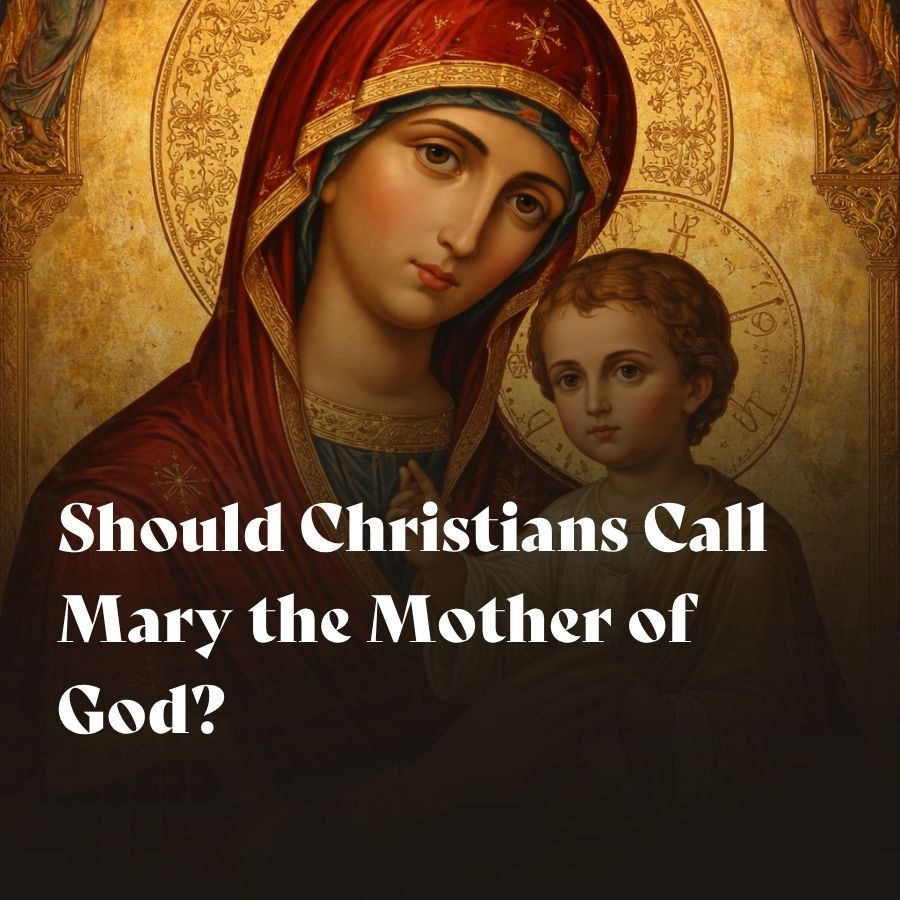
At this point, it is important to address a term that often enters this discussion, Theotokos, which means “God-bearer” or commonly translated, “Mother of God.” This term was formally affirmed at the Council of Ephesus, and it was not originally about elevating Mary, but about protecting the truth about Christ. The concern at the time was to affirm that the one Mary bore was not merely a human person, but truly God in the flesh.
When understood in that context, the term serves a Christological purpose. It safeguards the unity of Christ’s person, that Jesus is one person with two natures, fully God and fully man. In that sense, the term can be helpful, because it protects against errors that would divide Christ or diminish His deity.
But here is where we need to be careful. A term that begins as a theological safeguard can be extended beyond its original purpose. When “Mother of God” is no longer functioning to clarify who Christ is, but begins to shape how we relate to Mary, it starts to move into territory that Scripture itself does not define.
As The Shape of Sola Scriptura rightly observes, “The church does not possess the authority to create new doctrines, but only to preserve and proclaim the doctrine delivered by the apostles.” That principle is crucial here. Because even if a term is historically meaningful, it must remain tethered to its original, biblical function. Once it is used to introduce new categories of relationship or devotion, it has moved beyond what the apostles themselves taught.
A Careful Look at the Early Church — Honor Without Overreach
At this point, some may assume that the early church clearly taught Mary as the spiritual mother of all believers. But when we actually look at the earliest sources, a more careful picture emerges. The early church did honor Mary, and rightly so, but that honor did not immediately take the form of the kind of devotional or relational language we see develop later.
Take Irenaeus of Lyons, for example. He famously describes Mary in contrast to Eve, writing, “The knot of Eve’s disobedience was loosed by the obedience of Mary.” This is a profound theological insight, but notice what it is doing. It is typological, placing Mary within the unfolding story of redemption, not establishing an ongoing maternal relationship between Mary and the church.
In fact, even later figures who speak highly of Mary are careful in how they frame her significance. Augustine of Hippo writes, “Mary is more blessed in receiving the faith of Christ than in conceiving the flesh of Christ.” That statement is striking, because it emphasizes that Mary’s greatest blessing is not her biological role, but her faith, placing her alongside all believers rather than above them in a unique relational category.
What this shows us is that while the early church deeply respected Mary, it did not uniformly or clearly articulate the idea that she is the spiritual mother of all believers in the way later traditions would. The seeds of honor are there, but the full category of “our mother” is not yet developed. And that distinction matters, because it reinforces the pattern we have already seen, Scripture defines her role, the apostles do not expand it, and the earliest church does not clearly establish what later becomes common language.
Development Over Time — From Honor to Expansion
As we move beyond the early church, something important begins to happen. The way Mary is spoken about does not remain static, it begins to develop, expand, and take on new dimensions. What started as honor rooted in Scripture gradually becomes something broader, something that begins to shape how believers relate to her, not just how they remember her.
In the centuries following the Council of Ephesus, the language surrounding Mary becomes increasingly elevated. The title Theotokos remains in place, but it begins to function not only as a Christological safeguard, but also as a foundation for further reflection on Mary’s role. Over time, this reflection moves beyond explanation and into expansion.
By the medieval period, this development becomes much more pronounced. Mary is not only honored as the mother of Jesus, she is increasingly spoken of as a compassionate intercessor and a spiritual mother to believers. Devotional practices begin to reflect this shift, and the language of “our mother” becomes more normalized within the life of the church.
This progression is crucial to understand. Because nothing here appears as a sudden contradiction of Scripture, instead, it unfolds as a gradual expansion beyond it. And that is often how theological drift occurs, not through outright denial, but through subtle additions. What begins as faithful reflection can, over time, become a new category that Scripture itself never established
By What Standard? The Question That Governs Everything
At this point, everything we’ve seen leads to one unavoidable question: by what standard are we determining what is true, appropriate, and binding for the Christian life? Because if something is not clearly taught in Scripture, and not modeled by the apostles, then on what basis does it become a category that believers are expected to embrace?
This is where the issue moves from Mary specifically to the foundation of theological authority itself. As By What Standard? God’s World, God’s Rules puts it, “The Christian must always ask, ‘By what standard?’ and the answer must be the Word of God alone.” That question cuts through everything, because it forces us to evaluate not just conclusions, but the basis for those conclusions.
If our standard is Scripture, then our categories must come from Scripture. Not from tradition alone, not from what feels meaningful, and not from what develops over time. Because once we allow something to become binding or normative apart from clear biblical warrant, we have shifted the foundation from divine revelation to human development.
And that is the real concern here. The issue is not whether calling Mary “our mother” feels reverent or meaningful. The issue is whether it is authorized by the Word of God. Because if it is not, then no matter how sincere it may be, it cannot carry the weight of Christian truth.
The Danger of Adding New Relational Categories
One of the most subtle, and yet most significant, ways theology can shift is through the introduction of new relational categories. These are not always presented as outright doctrines, but they shape how believers think, feel, and relate within their faith. And once a relational category is introduced, it rarely stays neutral, it begins to reshape devotion itself.
Scripture gives us a remarkably clear framework for how we relate to God. We are taught to approach God as Father, to trust in Christ as our one mediator, and to walk by the Spirit who dwells within us. These are not vague ideas, they are defined, repeated, and central to the Christian life. They form the structure of our identity and our relationship with God.
But when a new category is introduced, like referring to Mary as “our mother,” something begins to shift. Even if unintentionally, it creates a relational dynamic that Scripture itself does not establish. And over time, that dynamic can begin to influence how believers think about access to God, comfort in suffering, or even spiritual dependence.
That is why this matters so deeply. We are not just dealing with words, we are dealing with the structure of Christian devotion. And if that structure is not built entirely on what God has revealed, then even well-meaning language can lead us into patterns of thought and practice that Scripture never intended.
The Sufficiency of Scripture and the Limits of Development
At this point, everything we’ve seen presses us into a foundational doctrine: the sufficiency of Scripture. This means that God’s Word is not only true, but complete in all that it intends to teach for faith and life. It gives us every category we need to rightly understand salvation, the church, and our relationship to God.
This is why the question of development must be handled carefully. Not all development is wrong, there is a legitimate sense in which the church grows in clarity and precision over time. But that development must always remain within the boundaries of what Scripture reveals, never moving beyond it into new categories that the apostles themselves did not establish.
As The Sufficiency of Scripture reminds us, “To add to Scripture is not to strengthen it, but to undermine its sufficiency.” That statement cuts to the heart of the issue. Because once something becomes functionally necessary for how we think or speak about the Christian life, even if it is not found in Scripture, we are no longer operating from sufficiency, we are operating from addition.
And that is the tension. Calling Mary “our mother” may feel like a natural extension of honoring her, but if that category is not given to us in Scripture, then it is not a harmless development. It is a step beyond what God has revealed, and that is precisely where theological clarity begins to give way to confusion.
Honoring Mary Without Distorting Scripture
At this point, it is important to say clearly that rejecting the language of “Mary our mother” is not the same as rejecting honor for Mary. In fact, the opposite is true. The only way to truly honor Mary is to honor her in the way Scripture itself does, without adding to or reshaping her role.
Scripture calls her blessed among women, and that is not a small statement. She is chosen by God for a unique and unrepeatable role in redemptive history, and her response of humble faith stands as a powerful example for all believers. When we see her say, “Let it be to me according to your word,” we are seeing a model of trust, submission, and obedience that should shape our own lives.
But Scripture also places her within the broader category of believers. She is not presented as a mediator, not elevated as a source of spiritual access, and not given an ongoing relational role in the life of the church. Even in the Gospels, Jesus consistently redirects attention away from biological privilege and toward faith and obedience as the true markers of blessing.
That distinction protects both the honor of Mary and the clarity of the gospel. Because when we begin to elevate her beyond what Scripture reveals, we are not actually honoring her more, we are distorting the very framework that gives her honor its meaning. True reverence does not come from expansion, it comes from faithful alignment with God’s Word.
Clarity, Consistency, and Submission to Scripture
When everything is brought together, the issue before us becomes clear. This is not ultimately about Mary’s importance, Scripture has already settled that. The issue is whether we are willing to let Scripture define both our doctrine and our language, or whether we will allow meaningful traditions to expand beyond what God has revealed.
We have seen that Scripture honors Mary, but does not assign her a spiritual motherhood over believers. We have seen that the apostles never teach this category, that the earliest church does not clearly articulate it, and that its development emerges gradually over time. And we have seen that the interpretive move used to support it, if applied consistently, leads to conclusions we would all reject.
So the question now turns personal. Are we willing to be consistent in how we handle Scripture? Are we willing to let God’s Word set the boundaries, even when something sounds reverent, even when it has a long history, and even when it feels meaningful? Because true devotion is not measured by how much we can say, but by how faithfully we say only what God has said.
In the end, clarity is not found in expanding our theological language, but in submitting it to Scripture. And when we do that, we are not losing anything of value, we are preserving the very foundation that keeps our faith anchored, our worship pure, and our understanding of Christ and His work undistorted and true.
Book Recommendations
The Shape of Sola Scriptura by Keith A. Mathison
By What Standard? God’s World, God’s Rules by Greg Bahnsen
The Sufficiency of Scripture edited by Don Kistler
© 2026 Jayni Jackson. All rights reserved.
Scripture quotations are from the ESV® Bible (The Holy Bible, English Standard Version®), unless otherwise noted.
Written by Jayni Jackson, creator of Least of These Podcast.
You may share this article with proper attribution, but you may not reproduce it in full without written permission.
If this article helped you think more clearly about Scripture, consider sharing it or subscribing for more content.


Comments